
Become ARMENIAN
SPEAK LIKE A REAL NATIVE
AUTHENTIC ARMENIAN LIVING
From its ancient roots as one of the world’s earliest Christian nations to its role as a cultural and spiritual crossroads, Armenia has played a vital role in world history. Established as a kingdom over two millennia ago, Armenia’s golden age saw the flourishing of its unique alphabet, architectural masterpieces, and enduring traditions. Influences from Persian, Roman, Byzantine, and Ottoman empires are woven into its cultural tapestry, all while retaining deeply rooted Armenian identity. From its ancient monasteries nestled in breathtaking landscapes to its vibrant traditions, Armenia offers a timeless journey through its dynamic and enduring legacy.
After regaining independence from the Soviet Union in 1991, Armenia embarked on a path of resilience and transformation. With a renewed focus on education, technology, and cultural preservation, Armenia has become a hub for innovation and creativity. Its thriving diaspora strengthens its global connections, while its traditions in winemaking, music, and culinary arts continue to captivate visitors. Today, Armenia is a beacon of perseverance and pride, celebrated for its unique language, rich heritage, and the warmth of its people.
We’ve curated a selection of hundreds of cultural insights and unique Armenian words to help you connect with the soul of Armenia. These phrases and expressions, often overlooked in traditional courses, will make you feel like a true native.
Speak and think like a real Armenian!

EXPAND YOUR KNOWLEDGE
If you are serious about learning Armenian, we recommend that you download the Complete Armenian Master Course.
You will receive all the information available on the website in a convenient portable digital format as well as additional contents: over 15.000 Vocabulary Words and Useful Phrases, in-depth explanations and exercises for all Grammar Rules, exclusive articles with Cultural Insights that you won't find in any other textbook so you can amaze your Armenian friends thanks to your knowledge of their country and history.
With a one-time purchase you will also get hours of Podcasts to Practice your Armenian comprehension and speaking in order to achieve your own Master Certificate.
Start speaking Armenian today!

Ախպար
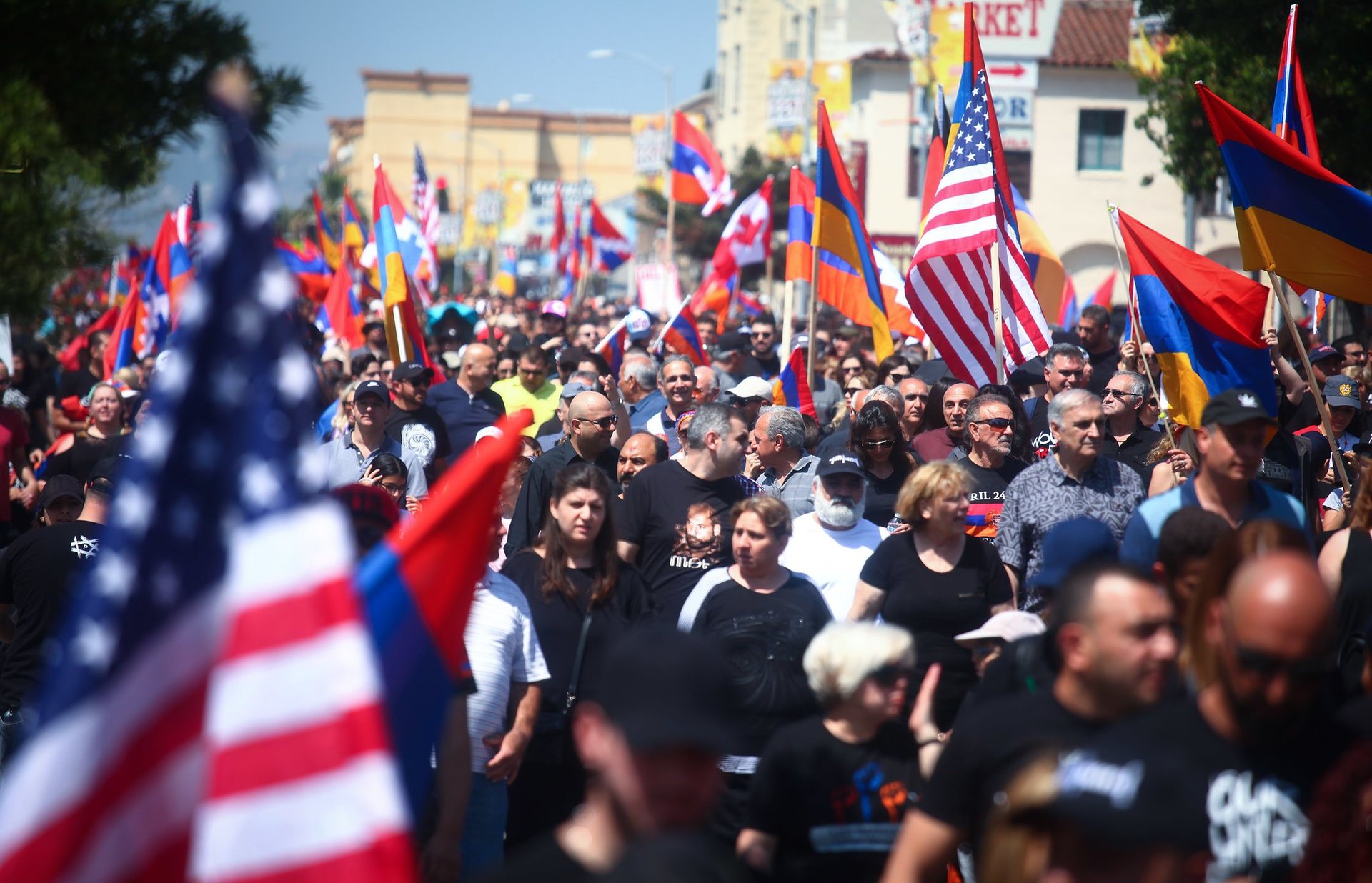
Ախպար (akhpar, diaspora Armenian) is a term historically used in Armenia to describe Armenians arriving from the diaspora, particularly those who settled in the country during the twentieth century. The word originally carried a descriptive meaning, identifying people whose Armenian language, customs, and everyday behavior had been shaped outside the historical homeland. Over time, it evolved into a socially loaded label reflecting broader tensions between local Armenians and repatriates.
The most significant period associated with the use of this term followed the large-scale repatriation waves of the late 1940s, when Armenians from the Middle East, Europe, and the Americas relocated to Soviet Armenia. These newcomers often spoke Western Armenian or heavily accented Eastern Armenian, practiced different religious customs, and brought social habits influenced by French, Arabic, Persian, or Russian cultural environments. These visible differences made the term a convenient shorthand in everyday speech.
In many cases, the word acquired a mildly pejorative tone, reflecting suspicion or social distance rather than hostility. Locals sometimes perceived diaspora Armenians as outsiders unfamiliar with Soviet realities, while repatriates often felt marginalized or misunderstood. The term thus came to symbolize not only migration status but also a divide shaped by historical experiences, economic expectations, and political conditions. Despite this, many diaspora Armenians made substantial contributions to education, science, arts, and urban development in Armenia.
Linguistically, the term is believed to derive from colloquial speech rather than classical Armenian usage. Its spread was largely oral, reinforced through daily interactions rather than formal writing. Because of this, its meaning varied by region, tone, and context. In some families, it functioned as a neutral descriptor, while in others it implied cultural difference or social friction. The flexibility of the term made it enduring but also controversial.
In contemporary Armenia, the meaning has shifted again. Since independence, migration flows have diversified, and contact between Armenia and its global diaspora has intensified through travel, business, and digital communication. Younger generations increasingly use the word with irony or historical awareness, recognizing its past while questioning its relevance. In many contexts, it has lost its sting and is now understood as a marker of a specific historical moment rather than a rigid identity category.
Today, the term remains an important lens through which to examine questions of belonging, identity, and cultural continuity within Armenian society. Its history reflects the broader Armenian experience of dispersion and return, highlighting how language encodes social memory and collective negotiation of difference.
Արցախ
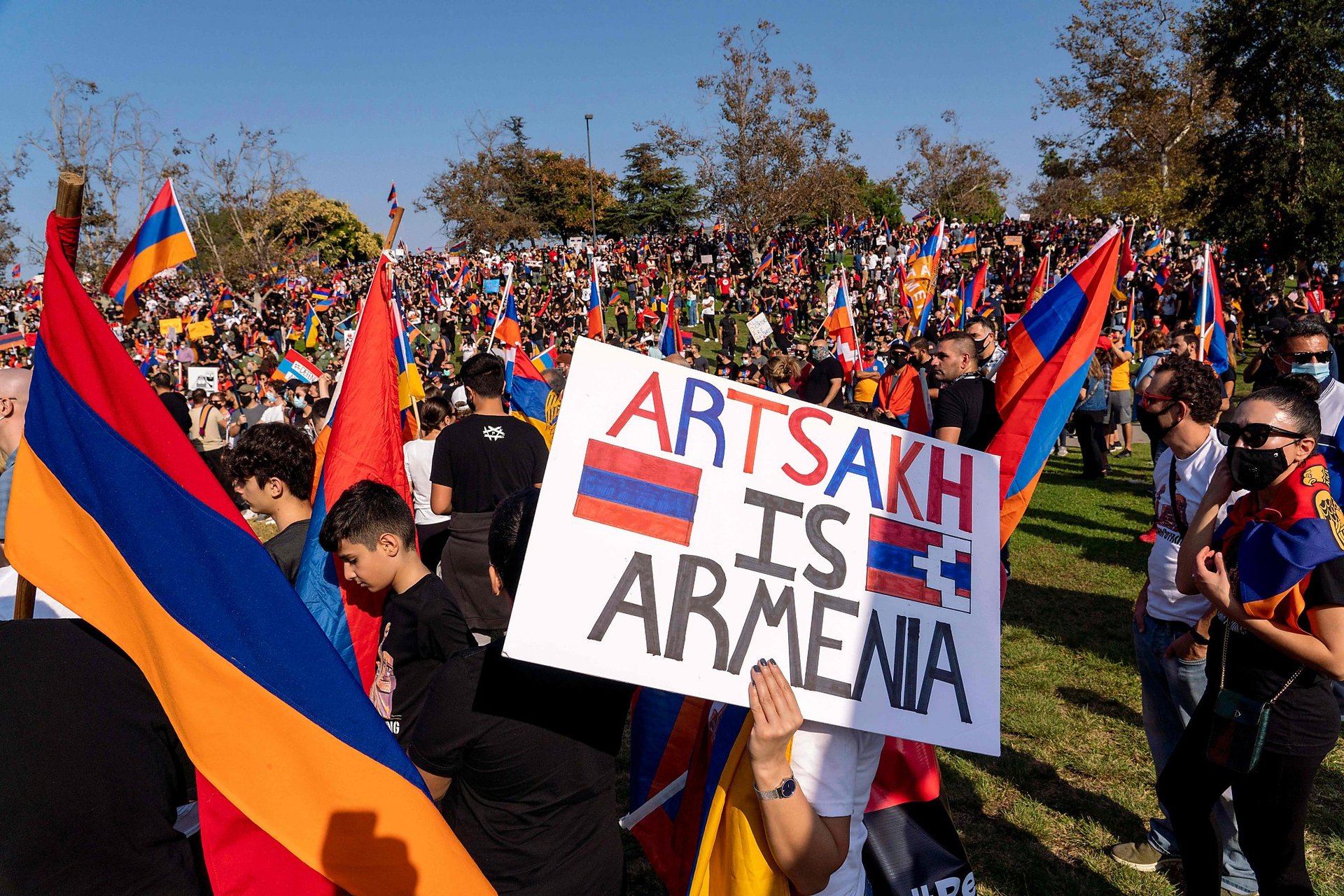
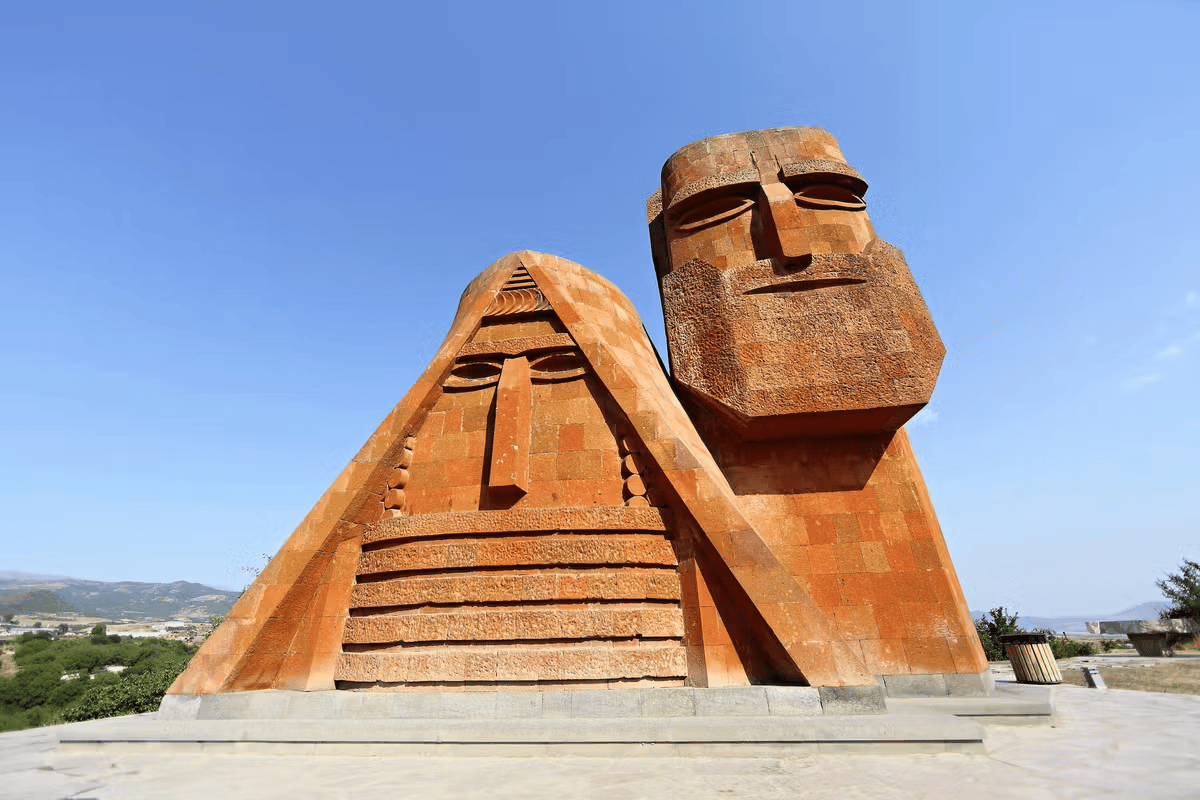
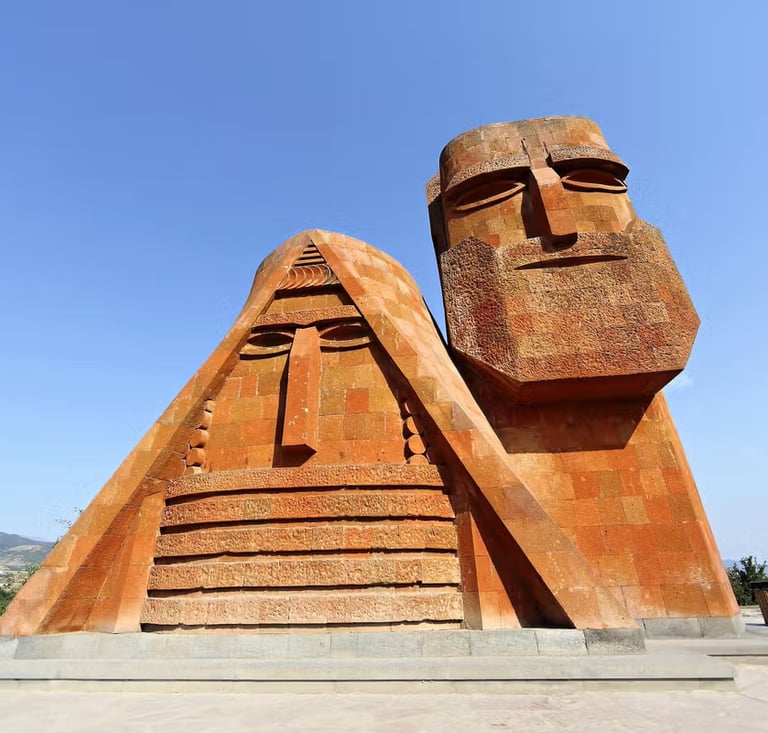
Արցախ (Artsakh, historical Armenian region) is one of the ancient provinces of Greater Armenia and occupies a central place in Armenian historical consciousness. Known internationally in recent decades as Nagorno-Karabakh, the region has been continuously associated with Armenian statehood, culture, and ecclesiastical life since antiquity. Classical Armenian sources describe it as a strategically and spiritually significant territory, characterized by fortified settlements, monasteries, and a predominantly Armenian population.
In antiquity and the early medieval period, Artsakh functioned as a semi-autonomous region under Armenian kings and later under local princely houses. The most notable of these were the Armenian melikdoms, which governed the region from the late medieval era into the early modern period. These local rulers maintained Armenian administrative structures, military forces, and church institutions, preserving autonomy despite shifting imperial control by Persian and Ottoman powers.
The region is densely marked by Armenian architectural heritage. Monasteries such as Gandzasar and Dadivank served not only as religious centers but also as hubs of education, manuscript production, and political coordination. These sites reinforced the region’s role as a bastion of Armenian Christianity and literacy during periods of external domination. Inscriptions and archaeological remains provide extensive evidence of long-term Armenian presence and cultural continuity.
In the nineteenth century, following the incorporation of the South Caucasus into the Russian Empire, Artsakh became part of the Elisabethpol Governorate. Demographic records from this period indicate a strong Armenian majority in mountainous areas. After the collapse of the Russian Empire and the formation of Soviet rule, the region was placed within the Azerbaijan Soviet Socialist Republic in 1921 as an autonomous oblast, despite its Armenian population. This decision laid the foundation for future conflict.
In the late twentieth century, the region became the focal point of a protracted and violent dispute following the dissolution of the Soviet Union. Armenians in the region sought self-determination, leading to armed conflict and mass displacement on both sides. The issue evolved into one of the most enduring and complex conflicts in the post-Soviet space, deeply affecting regional stability and Armenian national identity.
Beyond politics, Artsakh holds profound symbolic significance for Armenians worldwide. It represents endurance, historical continuity, and the defense of cultural heritage under pressure. References to the region in literature, music, and public discourse often emphasize sacrifice and collective responsibility. The region’s churches, cemeteries, and villages are viewed not merely as territory but as repositories of memory.
Today, discussions surrounding the region remain highly sensitive and contested. Regardless of current political realities, its place in Armenian history is firmly established through centuries of documented presence, cultural production, and lived experience. As such, it continues to function as a core element of Armenian historical narrative and identity formation.
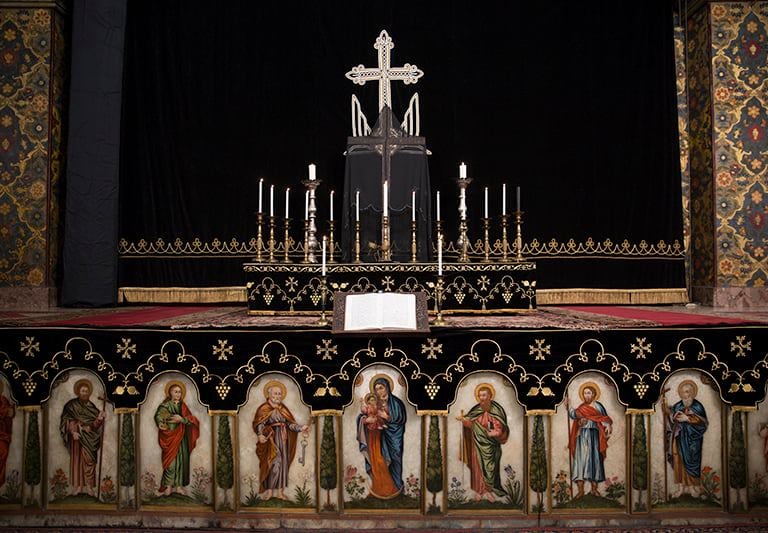
Ավագ շաբաթ
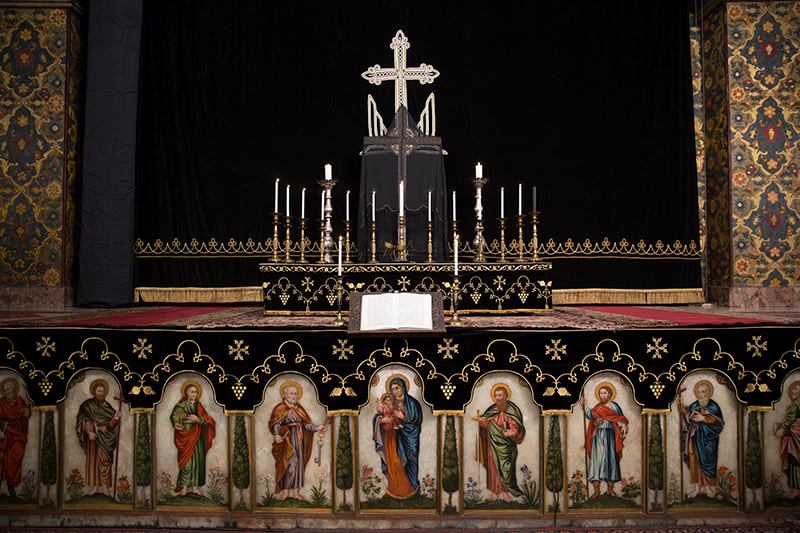
Ավագ շաբաթ (avag shabat, Holy Week) refers to the final and most solemn week of Lent in the Armenian Apostolic Church, preceding Easter. It commemorates the last days of Jesus Christ’s earthly life, from his entry into Jerusalem to the Crucifixion and burial. This period occupies a central position in the Armenian liturgical calendar and is marked by intense spiritual reflection, ritual observance, and communal worship.
The week begins after Palm Sunday and unfolds through a sequence of church services that reenact key moments of the Passion. Each day carries specific theological meaning and is associated with distinct readings from the Gospels. These services emphasize themes of sacrifice, humility, betrayal, and redemption, guiding the faithful through a structured progression toward Easter. Attendance at church during this week is traditionally encouraged, even among those who may be less observant during other times of the year.
One of the most significant days is Holy Thursday, which commemorates the Last Supper. During the liturgy, the institution of the Eucharist is recalled, and in many churches a ceremonial washing of feet is performed by clergy, symbolizing Christ’s act of humility toward his disciples. This ritual underscores ethical teachings related to service, compassion, and moral responsibility within the Christian life.
Holy Friday is the most solemn day of the week and is dedicated to the remembrance of the Crucifixion. Church services on this day are austere, often conducted without the Divine Liturgy. The focus is placed on mourning, repentance, and contemplation of suffering. The symbolic burial of Christ is enacted through liturgical rites, reinforcing the gravity of the event. Many believers observe a strict fast, abstaining from food until evening or later.
Holy Saturday serves as a transitional moment between mourning and celebration. It commemorates Christ’s descent into the realm of the dead and anticipates the Resurrection. The liturgical tone begins to shift subtly, moving from sorrow toward hope. Preparations for Easter take place both in churches and homes, including the baking of festive bread and the dyeing of eggs, which symbolize new life.
Beyond its religious dimensions, this period also shapes social and cultural behavior. Loud music, celebrations, and public festivities are traditionally avoided. The atmosphere is one of restraint and inward focus. In Armenian communities, this shared observance reinforces collective rhythm and continuity, linking individual households to the wider ecclesiastical tradition.
Գառնու տաճար
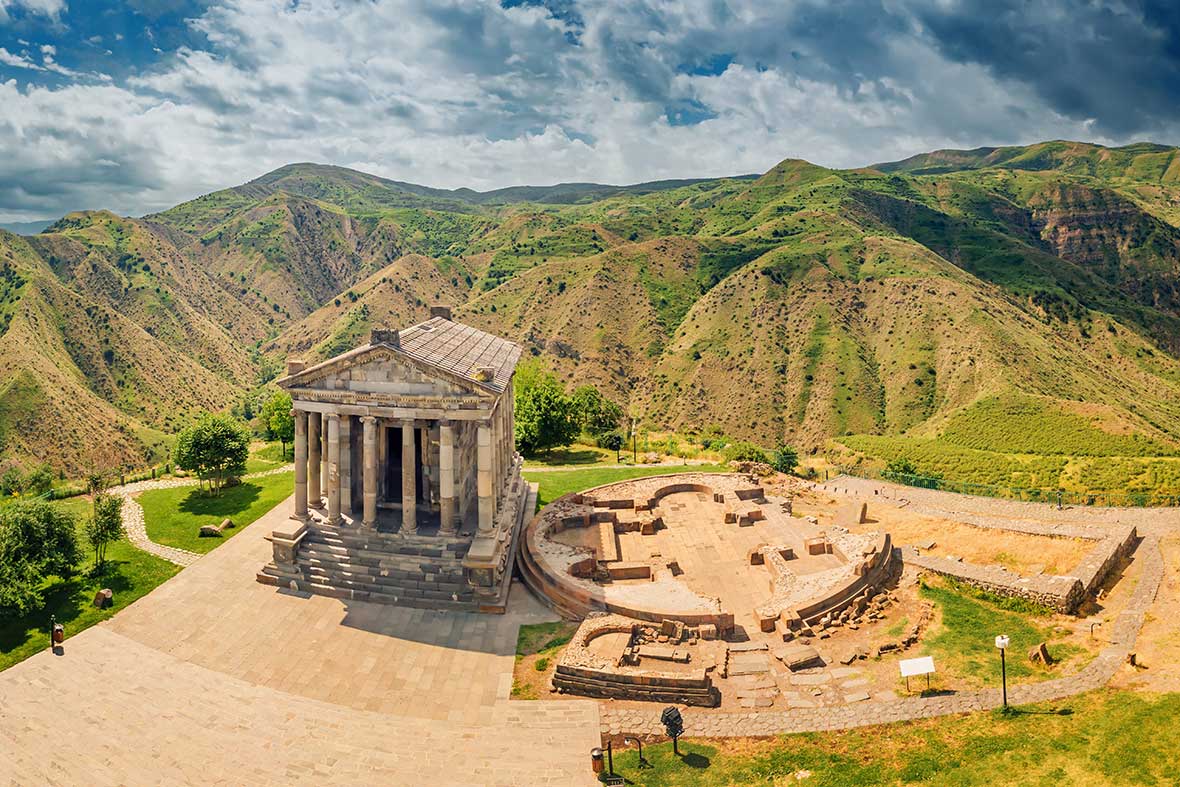
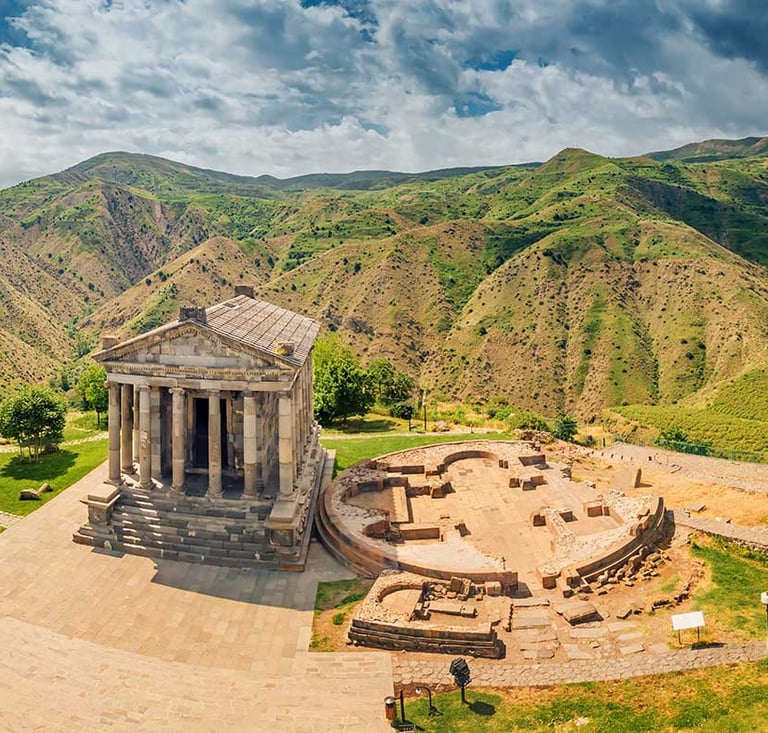
Գառնու տաճար (Garnu tachar, Garni Temple) is one of the most significant architectural and cultural monuments in Armenia and the only surviving Greco-Roman–style pagan temple in the country. Located in the village of Garni in the Kotayk region, the structure stands on a triangular plateau overlooking the Azat River gorge. Its commanding position and distinctive architectural form have made it a symbol of Armenia’s pre-Christian heritage.
The temple is generally dated to the first century CE and is traditionally associated with King Tiridates I of Armenia. An inscription discovered on the site suggests it was built under royal patronage, likely dedicated to the sun god Mihr, a deity linked to light, order, and royal authority in Armenian pagan belief. The adoption of classical architectural forms reflects Armenia’s political and cultural engagement with the Roman world during this period.
Architecturally, the structure follows the classical peripteral temple model, with a cella surrounded by Ionic columns. Built from locally quarried basalt, its precision-cut stone blocks demonstrate advanced engineering and aesthetic sophistication. The harmony of proportions, column spacing, and decorative details closely aligns with Greco-Roman norms while adapting them to local materials and landscape. This combination highlights Armenia’s role as a cultural intermediary between East and West.
Following the adoption of Christianity as the state religion in the early fourth century, most pagan temples in Armenia were destroyed or repurposed. The survival of the Garni Temple is exceptional. Scholars suggest it may have been preserved due to its use as a royal summer residence or its transformation into a secular structure rather than a place of worship. Its continued existence provides rare physical evidence of Armenia’s pagan past.
The monument suffered significant damage during an earthquake in 1679, collapsing almost entirely. For centuries, it remained in ruins, with fallen stones scattered across the site. In the twentieth century, a large-scale reconstruction project was undertaken using original stones and detailed archaeological documentation. Completed in 1975, this restoration was one of the earliest examples of anastylosis in the Soviet Union and sparked debate about reconstruction ethics, but it also ensured the monument’s preservation.
Beyond the temple itself, the surrounding complex includes remnants of a royal palace, bathhouse, and mosaic floors, indicating that the site functioned as a multifunctional ceremonial and residential center. These elements provide valuable insight into elite life and artistic practices in ancient Armenia.
Բարեկենդան
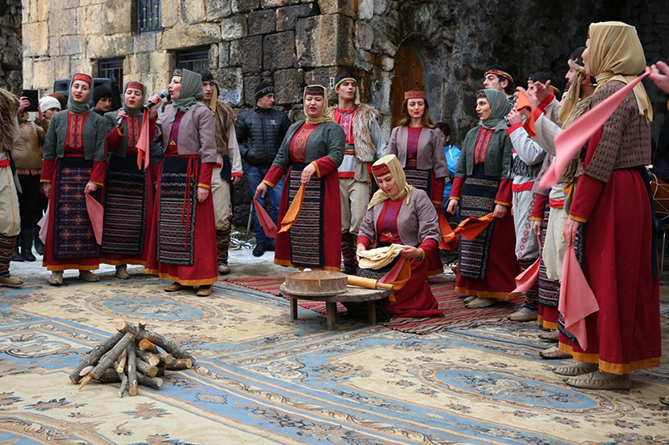
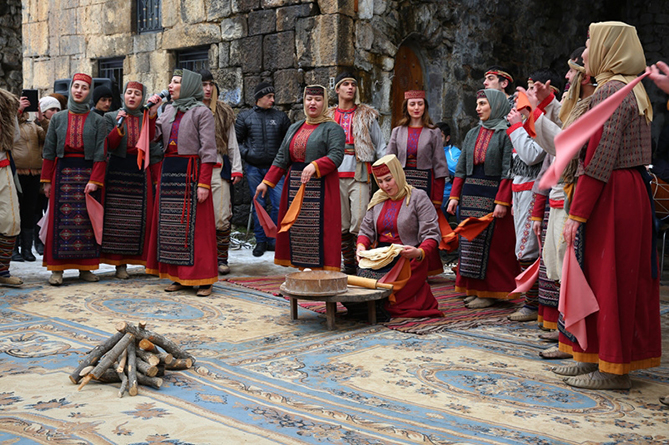
Բարեկենդան (barekendan, pre-Lenten carnival) is a traditional Armenian festivity marking the period immediately before the beginning of Great Lent in the Armenian Apostolic Church. It functions as a transitional celebration situated between ordinary time and the strict fasting and penitence that characterize Lent. Historically, it combined religious preparation with communal enjoyment, serving both spiritual and social purposes.
The celebration has deep roots that predate Christianity and are linked to seasonal cycles, fertility, and renewal. With the Christianization of Armenia in the fourth century, these older practices were not abolished but reinterpreted within a Christian framework. The festival came to symbolize a final moment of abundance and joy before a prolonged period of restraint. This layered origin explains why the celebration contains both sacred and secular elements.
Traditionally, the celebration involved communal feasting, theatrical games, music, and playful role reversals. Rich foods such as meat, dairy, and pastries were consumed in large quantities, as they would be avoided during Lent. Families prepared elaborate meals, and villages often organized public gatherings. Humor and satire were central features, allowing people to mock authority, exaggerate social roles, and temporarily suspend everyday hierarchies.
Masks and disguises played an important role in many regions. Participants dressed as animals, mythological figures, or exaggerated social types, reinforcing the carnivalesque nature of the event. These performances were not merely entertainment but reflected symbolic themes of chaos preceding order, excess preceding discipline, and winter yielding to spring. Through ritualized play, communities expressed shared values and anxieties.
From a religious perspective, the celebration served as psychological and social preparation for Lent. By marking a clear boundary between indulgence and abstinence, it reinforced the discipline required for fasting. Clergy traditionally tolerated or even acknowledged the festivities, recognizing their role in maintaining communal balance. The contrast between the celebration and the austerity that followed heightened the spiritual significance of Lent.
During the Soviet period, public celebration declined due to restrictions on religious and traditional observances. However, the festival survived in private spaces and in rural areas where customs were more resilient. After independence, there has been renewed interest in reviving traditional celebrations, often framed as expressions of national heritage rather than purely religious practice.

Գաթա
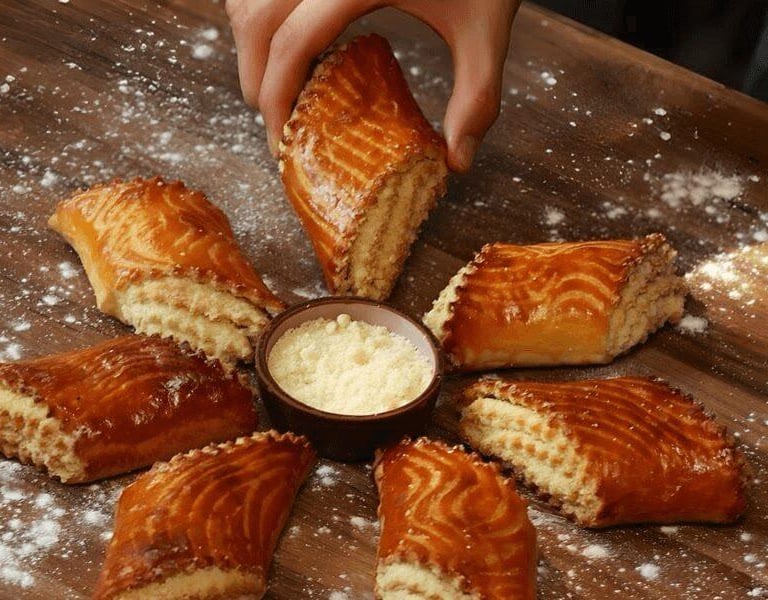
Գաթա (gata, sweet pastry) is one of the most recognizable and enduring elements of Armenian culinary tradition. It refers to a family of baked pastries characterized by a rich dough and a sweet filling, commonly made from flour, butter, sugar, and sometimes nuts. Its presence spans everyday домаш cooking, ritual occasions, and regional identity, making it both a food item and a cultural marker.
The preparation of this pastry varies significantly by region, reflecting local ingredients, techniques, and symbolic meanings. In some areas it is shaped as a flat, round bread, while in others it takes the form of layered rolls or individual portions. The filling, often called khoriz, may be dry and crumbly or moist and dense, depending on regional preference. These variations are not considered deviations but legitimate expressions of local tradition.
Historically, the pastry has been closely associated with festive and ritual contexts. It is commonly prepared for religious holidays, family celebrations, and life-cycle events such as weddings or house blessings. In certain regions, a coin or symbolic object is hidden inside the pastry during New Year or Epiphany celebrations, and the person who finds it is believed to receive good fortune. This practice links food preparation to concepts of fate, prosperity, and communal sharing.
The role of this pastry extends beyond consumption. Its preparation is often a collective activity, especially in rural settings, involving multiple generations. Recipes are transmitted orally, with measurements learned through practice rather than written instruction. This mode of transmission reinforces family continuity and gendered knowledge, as the responsibility for preparation has traditionally fallen to women within the household.
From a historical perspective, the pastry illustrates continuity in Armenian food culture despite centuries of political upheaval, migration, and scarcity. Even during periods of displacement, Armenians recreated it using available substitutes, preserving its symbolic meaning even when ingredients changed. In diaspora communities, it became a culinary link to the homeland, often adapted to new environments while retaining its recognizable form.
In contemporary Armenia, the pastry remains widely consumed and has also entered commercial production. Bakeries offer regional styles, and it is frequently marketed as a national specialty to visitors. Despite commercialization, home preparation continues to be valued as more authentic, emphasizing the distinction between cultural practice and commodity.
Դուդուկ
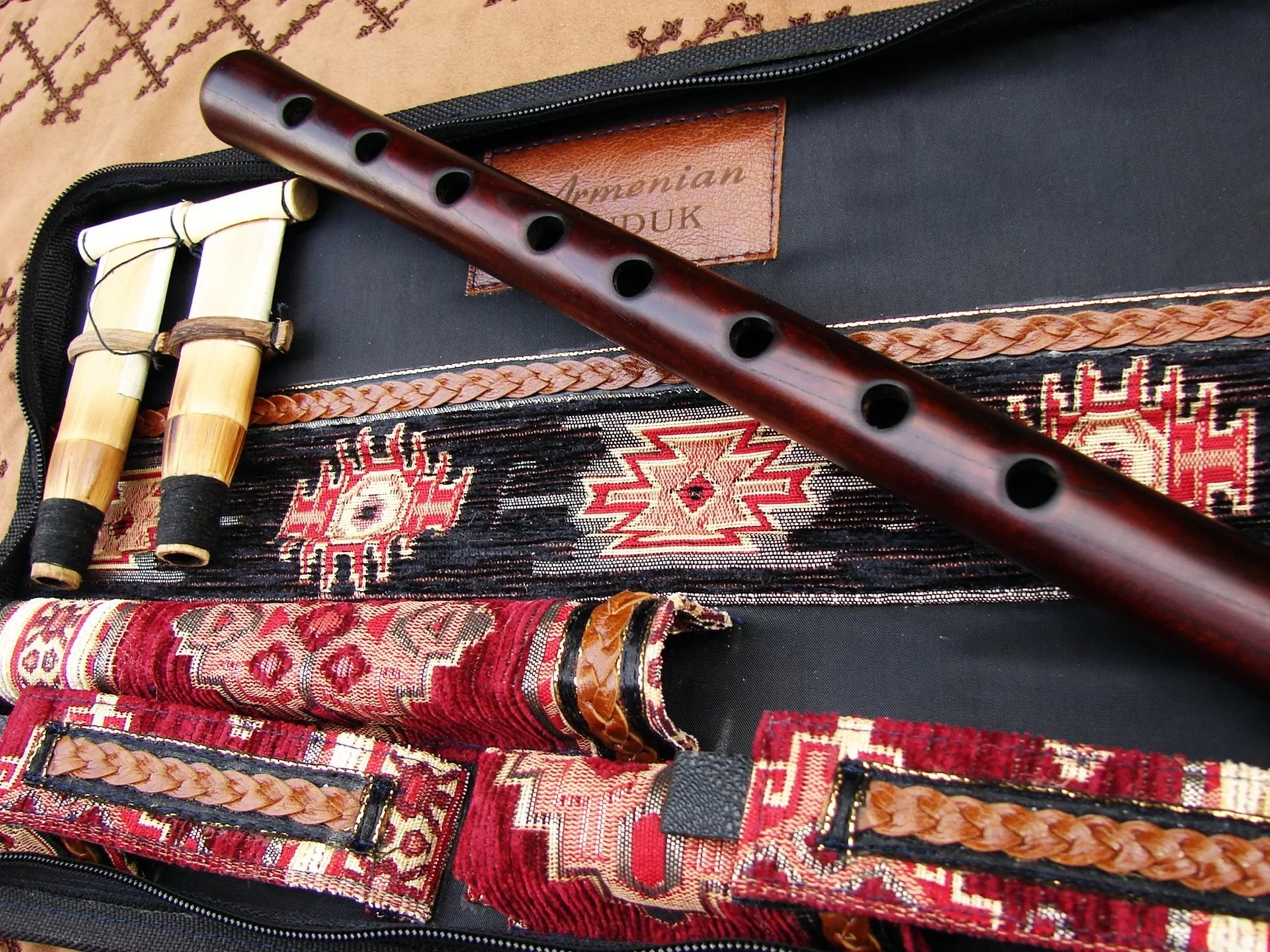
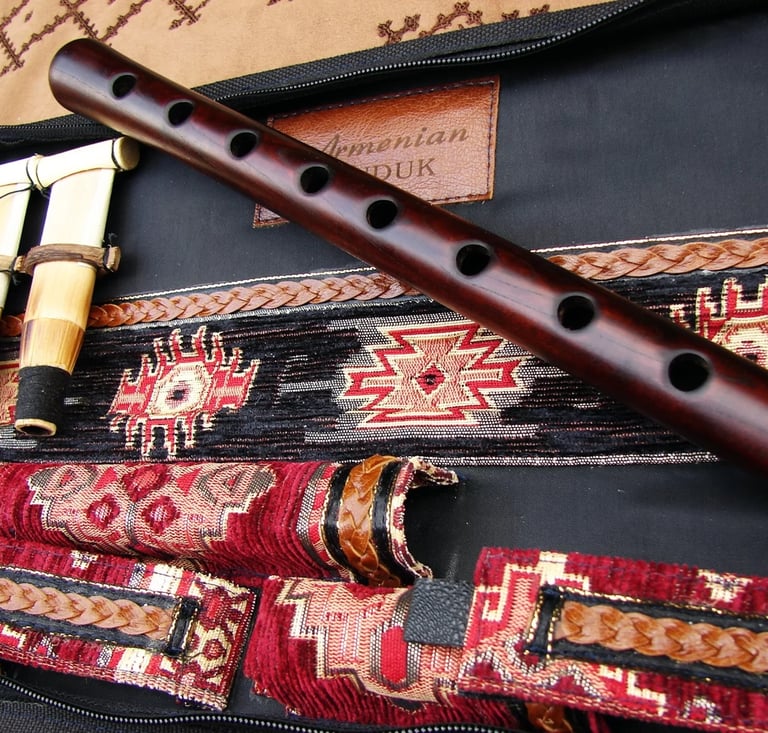
Դուդուկ (duduk, traditional woodwind instrument) is one of the most emblematic instruments of Armenian musical culture, widely recognized for its warm, breathy, and deeply expressive sound. Made traditionally from aged apricot wood and fitted with a large double reed, the instrument produces a timbre often described as human-like, capable of conveying sorrow, longing, and introspection. Its sound has become closely associated with Armenian identity and emotional expression.
The origins of the instrument are ancient, with references in Armenian sources dating back many centuries. Archaeological and textual evidence suggests that similar reed instruments were used in the Armenian Highlands in antiquity, particularly in ritual and ceremonial contexts. Over time, the instrument evolved in form and technique, becoming a central component of Armenian folk and ceremonial music. Its development reflects continuity in musical practice despite shifting political and cultural conditions.
Structurally, the instrument is relatively simple, consisting of a cylindrical wooden body with finger holes and a broad reed known as the ramish. The choice of apricot wood is culturally significant, as the apricot tree holds symbolic value in Armenian culture and is associated with the homeland itself. The tuning and pitch vary depending on regional styles, allowing the instrument to adapt to different musical modes and vocal ranges.
Performance practice traditionally involves two players. One musician plays the melody, while the second maintains a continuous drone using circular breathing. This technique creates a sustained sonic foundation over which the melody unfolds, enhancing the meditative and emotional quality of the music. Mastery of breath control is essential and is considered a defining skill of accomplished performers.
The instrument has historically accompanied major life events, including weddings, funerals, and communal gatherings. Its use in mourning rituals is particularly notable, as its sound is believed to articulate grief more effectively than words. At the same time, it is also used in celebratory contexts, demonstrating its expressive range and adaptability. This dual function underscores its role as a vehicle for collective emotion.
In the modern era, the instrument has gained international recognition. Armenian composers and performers introduced it to concert stages, film soundtracks, and cross-cultural collaborations. Its inclusion in global media has contributed to wider awareness of Armenian musical heritage. In 2005, UNESCO recognized Armenian duduk music as a Masterpiece of the Oral and Intangible Heritage of Humanity, further cementing its cultural significance.
Եռաբլուր
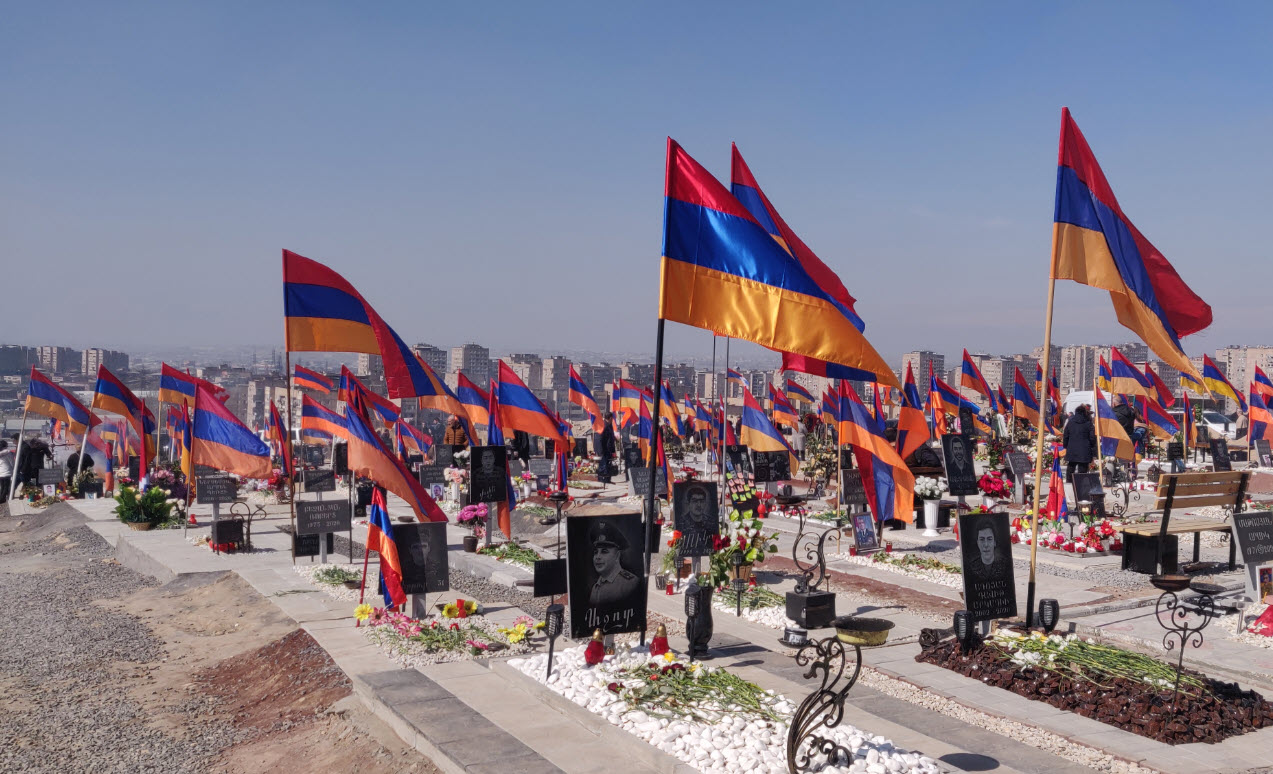
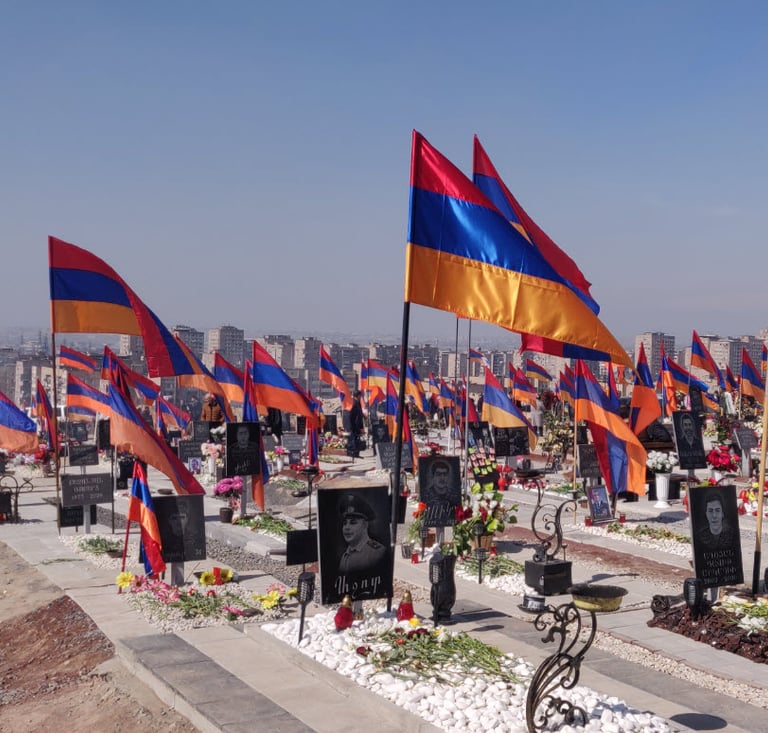
Եռաբլուր (yerablur, military cemetery) is the national military cemetery of Armenia, located on a hill overlooking Yerevan. It serves as the principal burial site for soldiers, officers, and national figures who died in defense of the Armenian state, particularly during the conflicts of the late twentieth and early twenty-first centuries. The site occupies a prominent physical and symbolic position, linking the capital city with the memory of sacrifice and national struggle.
The cemetery was formally established after Armenia’s independence, though burials began earlier during the conflict over Artsakh. As casualties increased, the need for a central place of remembrance became clear. The location was chosen for its visibility and elevation, reinforcing the idea of guardianship over the city below. From many points in Yerevan, the hill is visible, embedding remembrance into the daily visual landscape.
The site is organized with orderly rows of graves marked by headstones bearing photographs, names, dates, and military insignia. Many graves are accompanied by national symbols, flags, and personal items left by family members. This combination of standardized structure and individual expression reflects the dual function of the cemetery as both a state memorial and a deeply personal space of mourning.
Beyond burial, the site functions as a focal point for public commemoration. State ceremonies, military honors, and national days of remembrance are often observed there. Political leaders, foreign dignitaries, and delegations regularly visit the site to pay respects, reinforcing its role in official narratives of statehood and defense. These rituals contribute to the institutionalization of memory and the transmission of historical interpretation.
For families of the fallen, the cemetery is a place of ongoing relationship rather than static remembrance. Visits are frequent, especially on anniversaries and religious holidays. The maintenance of graves is treated as a moral duty, reflecting broader Armenian cultural values surrounding respect for the dead and continuity between generations. The site thus operates simultaneously on civic, familial, and spiritual levels.
In Armenian public discourse, the cemetery has come to symbolize the cost of sovereignty and the fragility of peace. References to it often appear in discussions about national security, political responsibility, and collective trauma. It represents not only past loss but also an ongoing reminder of unresolved conflict and the human consequences of geopolitical decisions.
Թառ
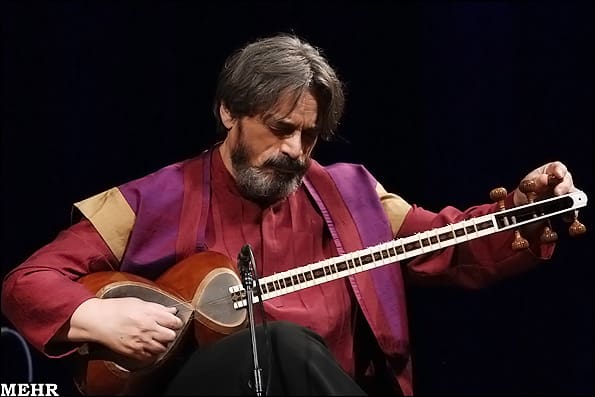
Թառ (tar, string instrument) is a long-necked plucked string instrument with deep historical significance in Armenian musical culture. It belongs to the family of lute-like instruments and has been used for centuries in both folk and classical traditions across the Armenian Highlands. The instrument is valued for its wide tonal range and expressive capacity, allowing performers to convey both rhythmic vitality and emotional nuance.
Historically, the instrument developed within a shared musical environment of the South Caucasus and neighboring regions, yet Armenian performance practice evolved distinct characteristics. Armenian musicians adapted tuning systems, playing techniques, and melodic structures to align with local modal traditions. Written sources and miniature paintings from the medieval period indicate the presence of similar instruments in courtly and urban musical life, suggesting its long-standing integration into Armenian culture.
Structurally, the instrument is typically carved from wood and features a double-bowl body, a long fretted neck, and multiple strings arranged in courses. The soundboard is often made of thin wood or animal membrane, contributing to its bright yet resonant tone. Craftsmanship plays a crucial role in sound quality, and instrument making has traditionally been passed down through specialized artisan families.
In performance, the instrument is commonly used in solo contexts as well as in small ensembles. It is capable of executing complex melodic ornamentation, rapid passages, and subtle microtonal inflections. These features make it particularly suited to modal music systems, where expressive detail and improvisational skill are highly valued. Mastery requires technical precision and deep familiarity with traditional modes.
Culturally, the instrument has been associated with professional musicians, storytellers, and urban performers rather than purely rural settings. It frequently accompanied poetry, vocal performance, and dance, functioning as both melodic lead and rhythmic support. In this role, it contributed to the transmission of oral literature and musical repertoire, reinforcing its place in Armenian cultural continuity.
During the modern era, especially in the nineteenth and twentieth centuries, Armenian musicians played an important role in preserving and formalizing its repertoire. With the rise of conservatories and written notation, performance practices were systematized, allowing the instrument to enter academic and concert settings. This institutionalization helped ensure its survival during periods of political and cultural disruption.
Տարազ
Տարազ (taraz, traditional folk costume) refers to the traditional clothing worn by Armenians across different historical regions, periods, and social contexts. It is not a single standardized outfit but a broad system of dress that varied according to geography, climate, occupation, age, and social status. As such, it provides valuable insight into Armenian social structure, aesthetic values, and regional diversity.
Historically, traditional costume developed in close relationship with local conditions. Mountainous regions favored heavy woolen fabrics for warmth, while lowland areas used lighter textiles such as linen and cotton. Color palettes, embroidery styles, and garment layers differed markedly from one region to another, allowing immediate visual identification of a person’s place of origin. This regional specificity made traditional dress an important marker of local identity within the broader Armenian cultural sphere.
The costume typically consisted of multiple components worn in layers. For women, this often included a long dress, apron, belt, head covering, and jewelry. For men, it usually involved trousers, a shirt, a fitted outer garment, and a belt, often used to carry tools or weapons. Each element had both practical and symbolic meaning, balancing functionality with visual expression. Embroidery motifs frequently carried protective or auspicious symbolism rooted in pre-Christian belief systems.
Social status and life stage were clearly encoded in traditional dress. The richness of fabric, complexity of decoration, and use of precious metals indicated wealth and rank. Marital status was especially important in women’s attire, with specific colors and accessories distinguishing unmarried girls, married women, and widows. These visual codes reduced ambiguity in social interaction and reinforced communal norms.
The production of clothing was largely domestic, with women responsible for spinning, weaving, sewing, and embroidery. Skills were transmitted orally and through practice, often within extended family structures. This process made clothing production an essential component of women’s cultural knowledge and labor. Garments were time-intensive to produce, increasing their value and durability.
From the nineteenth century onward, modernization and urban influence began to erode everyday use of traditional dress. European-style clothing became increasingly common, especially in cities, while traditional garments were gradually confined to rural areas and ceremonial contexts. Soviet policies further accelerated this shift by promoting uniformity and discouraging visible expressions of ethnic distinction. In contemporary Armenia, traditional costume is no longer worn in daily life but remains central to cultural representation.
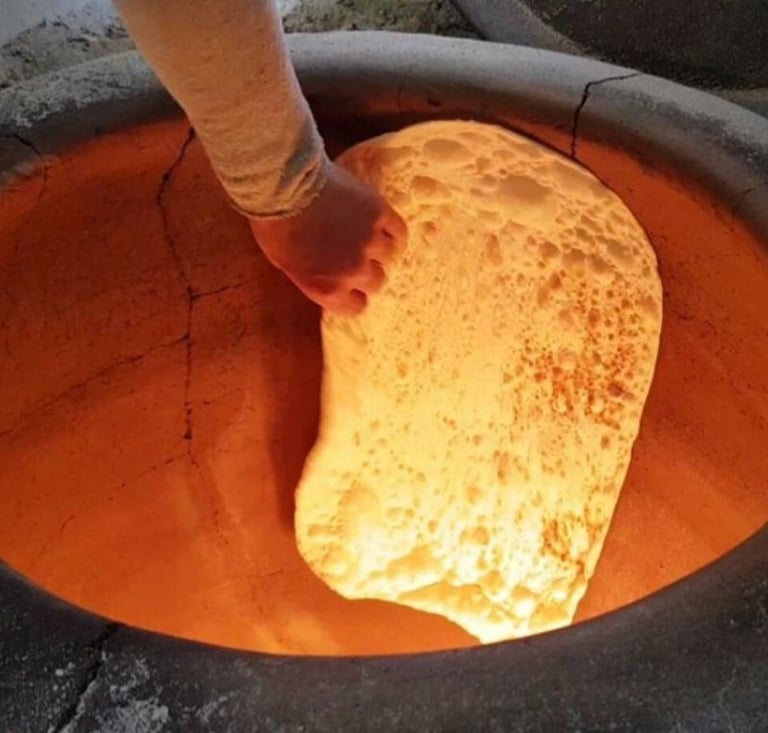
Թոնիր
Թոնիր (tonir, traditional clay oven) is a traditional underground oven that has played a central role in Armenian domestic life for centuries. It is primarily used for baking bread, especially lavash, but also for cooking meat, vegetables, and communal meals. Its design and use reflect a deep integration of culinary practice, architecture, and social organization within Armenian culture.
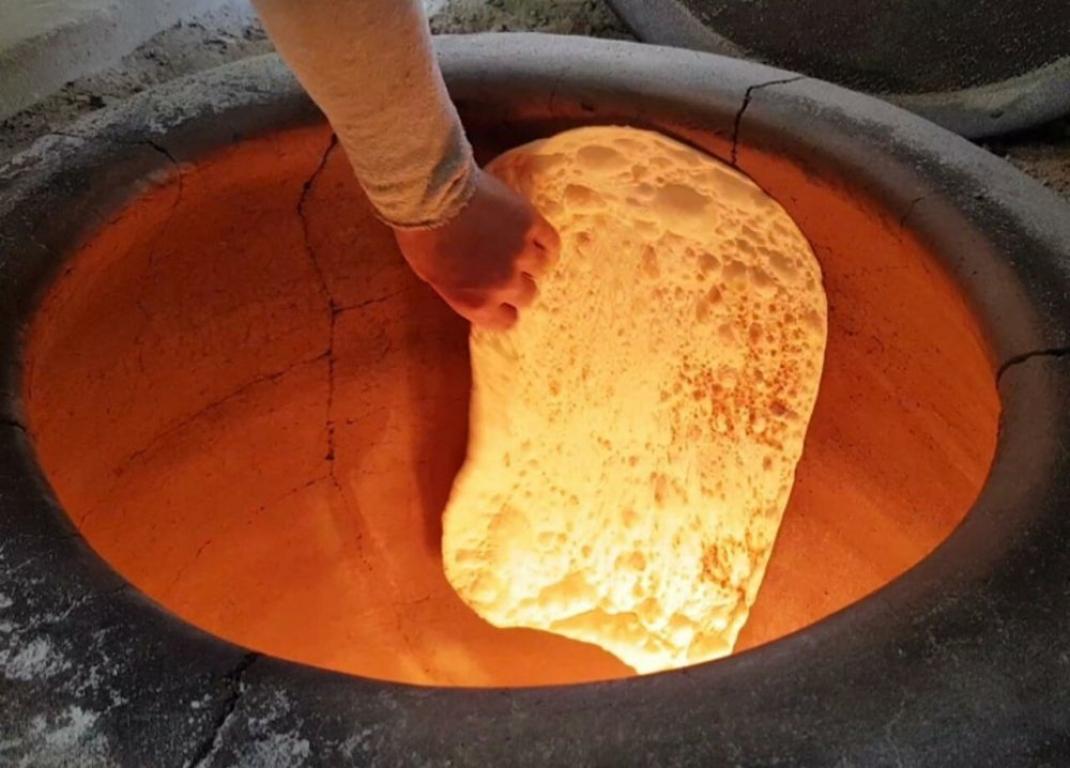
Structurally, the oven is a cylindrical clay-lined pit dug into the ground, with an opening at floor level. The interior walls are heated by burning wood or dried plant material until they reach high temperatures. Once the fire subsides, food is cooked using retained heat. This method allows for efficient fuel use and even cooking, making it particularly suited to rural environments with limited resources. The underground placement also provides insulation and safety.
Historically, the oven was a focal point of the household, especially in rural Armenia. It was commonly located in a dedicated room or courtyard area and was often shared by extended families or neighboring households. Baking sessions were collective events, with women gathering to prepare dough, bake bread, and exchange news. These gatherings reinforced social bonds and facilitated the transmission of culinary knowledge across generations.
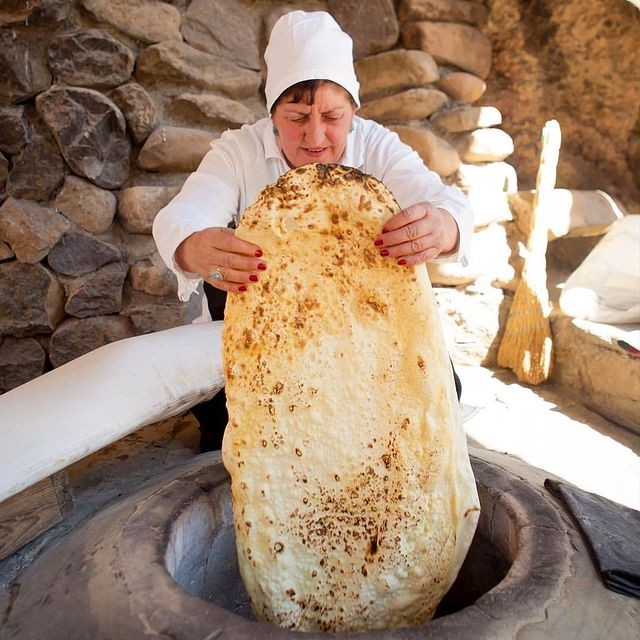
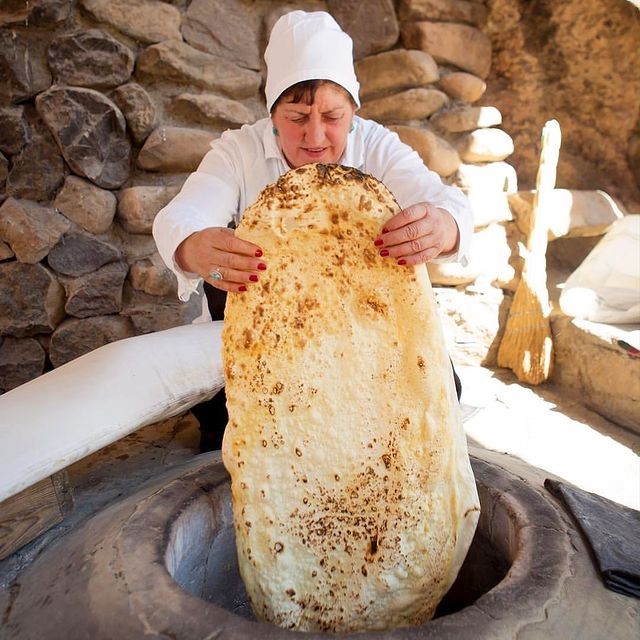
The oven is most strongly associated with lavash baking. Thin sheets of dough are skillfully stretched and slapped against the hot interior walls, where they bake within seconds. This technique requires coordination, experience, and precise timing. Mastery of this process was traditionally considered an essential skill for women, closely tied to household competence and social respect.
Beyond bread, the oven was used to prepare a wide range of foods. Meat could be lowered into the pit to slow-cook, while vegetables and legumes were baked in clay pots. In colder months, the residual warmth also served a practical purpose, helping heat living spaces. This multifunctional use highlights the oven’s importance as both a culinary and domestic technology.
The construction and maintenance of the oven carried ritual and symbolic meaning. Building a new one was often accompanied by specific customs, and its first use could be marked by shared meals or blessings. In Armenian belief, the hearth represented continuity, fertility, and protection. The oven thus functioned not merely as a tool but as a symbol of household stability and survival.
During the twentieth century, urbanization and the introduction of modern stoves led to a decline in everyday use, particularly in cities. However, it never disappeared entirely. In villages and cultural settings, traditional ovens continued to be used, and in recent decades there has been renewed interest in preserving this practice as part of national heritage.
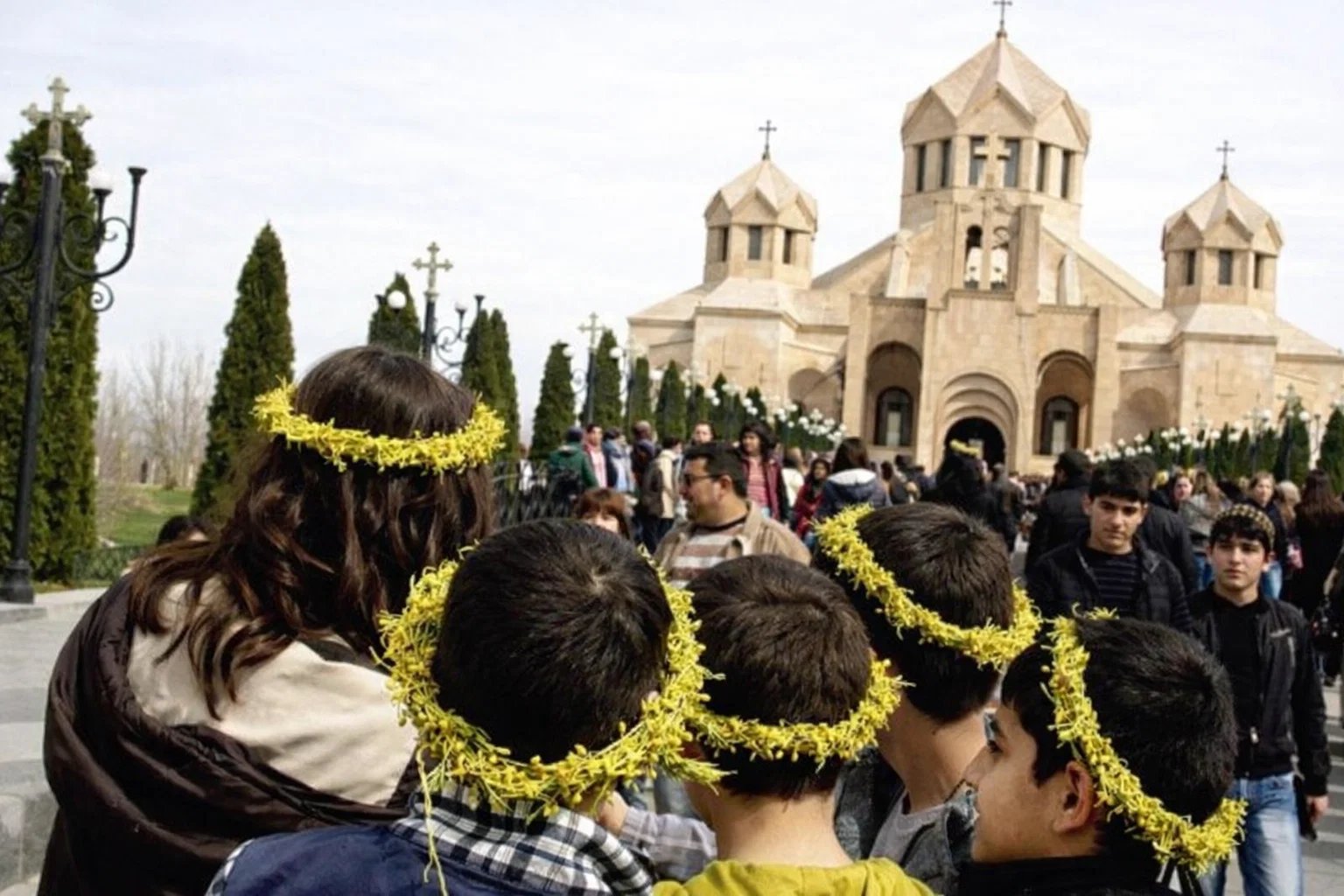
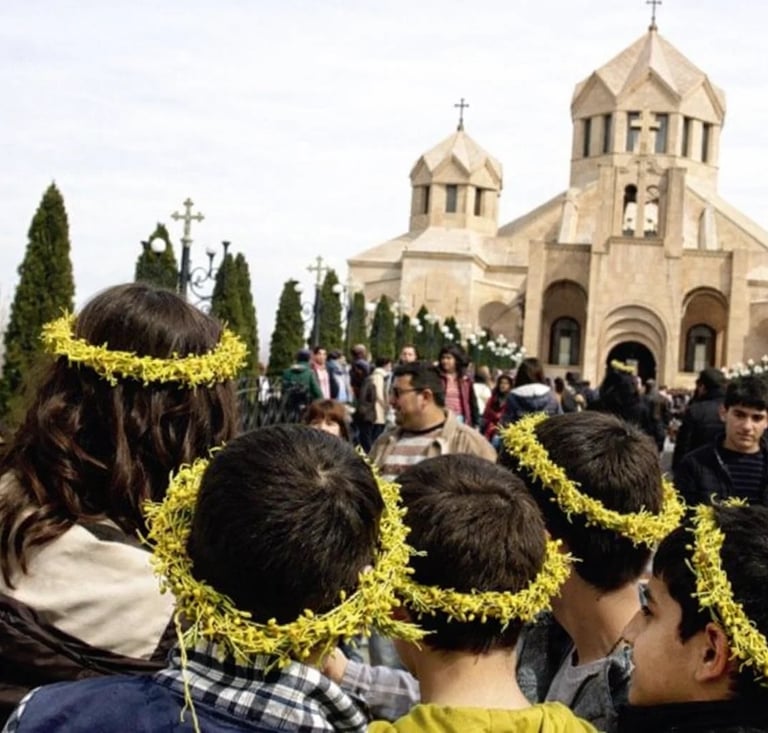
Ծաղկազարդ
Ծաղկազարդ (tsaghkazard, Palm Sunday) is the Armenian Apostolic Church’s celebration of Palm Sunday, commemorating the entry of Jesus Christ into Jerusalem. Observed one week before Easter, it marks the beginning of Holy Week and occupies a distinctive place in Armenian liturgical and popular tradition. The feast combines biblical commemoration with locally rooted customs centered on nature, renewal, and blessing.
In the Armenian context, palm branches were historically scarce, so local vegetation took their place. Willow branches, budding twigs, and early spring greenery became the primary ritual objects associated with the day. These branches are brought to church to be blessed during the liturgy and then taken home by the faithful. The use of living branches connects the feast to seasonal rebirth and the awakening of nature after winter.
Liturgically, the day emphasizes themes of humility, recognition, and anticipation. The Gospel readings recount Christ’s entry into Jerusalem and the crowd’s acclamation, foreshadowing both the Passion and the Resurrection. Church services on this day are festive but restrained, reflecting joy tempered by awareness of the suffering to come. Hymns and prayers focus on praise, transition, and spiritual readiness.
Culturally, the blessed branches are believed to carry protective and auspicious qualities. In many households, they are placed near icons, doorways, or windows. Some families keep them throughout the year, replacing them at the next celebration. This practice reflects a broader Armenian tradition in which religious objects are integrated into domestic space, blurring the boundary between church ritual and everyday life.
The day also has a strong association with children and youth. Historically, it was considered a celebration of innocence and renewal, and children often took part prominently in services and processions. In some regions, special songs or simple rituals emphasized the role of the younger generation, symbolically linking spiritual continuity with biological and social renewal.
Beyond its Christian framework, the feast preserves elements of pre-Christian seasonal celebration. The focus on greenery, fertility, and cyclical renewal suggests continuity with earlier agrarian rites that marked the transition from winter to spring. Rather than erasing these older meanings, Christian practice absorbed and reframed them, allowing multiple layers of symbolism to coexist.
During periods when public religious expression was restricted, especially in the Soviet era, observance continued quietly within families. Branches were blessed discreetly or collected informally, maintaining continuity despite external pressure. After independence, public celebration regained visibility, and churches once again became focal points for communal observance. In contemporary Armenia, the feast remains widely observed.
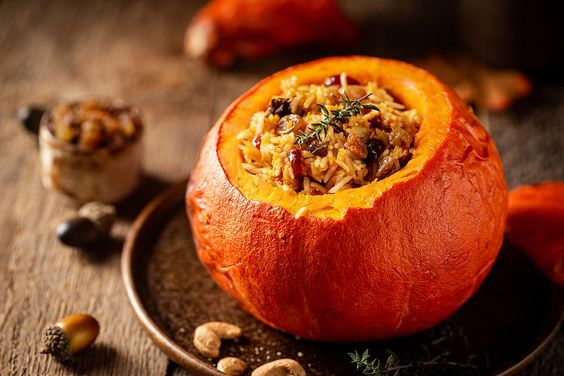
Ղափամա
Ղափամա (ghaphama, stuffed pumpkin dish) is a traditional Armenian festive dish prepared by stuffing a whole pumpkin with rice, dried fruits, nuts, honey, and spices, then baking it slowly until tender. It is most strongly associated with autumn and winter celebrations and occupies a symbolic place in Armenian cuisine as a dish of abundance, warmth, and hospitality. Its preparation and presentation reflect the close relationship between food, seasonality, and cultural meaning.
The dish is rooted in agrarian life, where pumpkins were valued for their durability, nutritional value, and ability to be stored through colder months. Combining the pumpkin with grains, fruits, and nuts created a nutritionally dense meal suited to communal consumption. Ingredients such as raisins, dried apricots, walnuts, and cinnamon were chosen not only for flavor but also for their availability and preservability, making the dish practical as well as celebratory.
Traditionally, the dish is prepared for major family gatherings, religious holidays, and New Year celebrations. It is often brought to the table whole and opened ceremonially, revealing the rich filling inside. This act of opening carries symbolic meaning, representing generosity, fullness, and shared prosperity. The visual impact of the dish reinforces its role as a centerpiece rather than an ordinary meal.
Preparation is typically a collective process. Family members participate in cleaning the pumpkin, preparing the filling, and assembling the dish. This shared labor reinforces social bonds and allows culinary knowledge to be transmitted informally across generations. Recipes are rarely fixed, with proportions adjusted according to taste, regional custom, and available ingredients, highlighting the adaptability of the tradition.
The dish also carries metaphorical significance in Armenian cultural expression. It is sometimes referenced in songs, sayings, and humor as a symbol of plenitude and domestic warmth. Its association with sweetness and fullness contrasts with periods of fasting or austerity, making it particularly meaningful in the cycle of feasts and fasts that structure Armenian culinary life.
During the Soviet period, economic limitations and standardized food production reduced the frequency of elaborate traditional dishes. Nevertheless, the dish survived in household practice and regained prominence after independence, when renewed interest in national cuisine emerged. It became a symbol of culinary heritage and was promoted through festivals, media, and cultural programming.
Խաշ
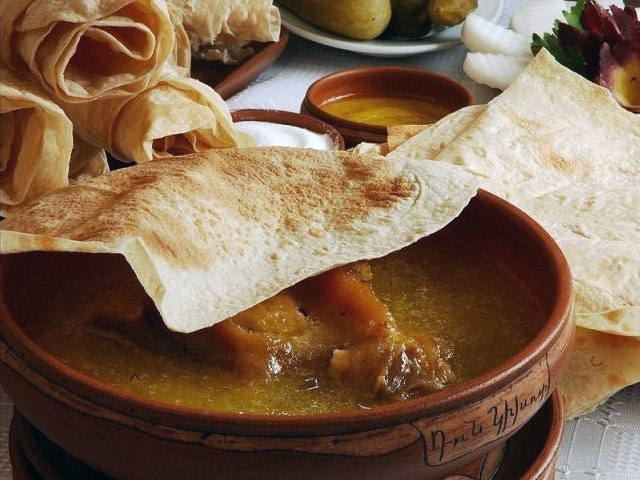
Խաշ (khash, traditional winter dish) is a long-established Armenian dish made primarily from boiled cow or sheep’s feet, prepared slowly over many hours and traditionally eaten early in the morning. It occupies a distinctive place in Armenian food culture, not only because of its ingredients but also due to the social rituals and seasonal practices surrounding its consumption. The dish is strongly associated with winter and communal gathering.
Historically, the dish emerged from practices of whole-animal use in agrarian societies, where no part of livestock was wasted. The prolonged boiling process extracts gelatin and nutrients, producing a rich broth with a dense texture. Because of its warming and sustaining qualities, the dish was especially valued during cold months, when physical labor was demanding and fresh food scarce.
Preparation traditionally begins the night before consumption. The feet are thoroughly cleaned, soaked, and boiled for many hours without salt. This lengthy process requires planning and patience, reinforcing the idea that the dish is not casual food but a deliberate event. Seasoning is added individually at the table, most commonly with crushed garlic, salt, and dried flatbread.
The social dimension of the dish is central to its cultural significance. It is rarely eaten alone and is instead associated with gatherings of family members, friends, or colleagues. These gatherings typically take place early in the morning, sometimes before sunrise, and follow a recognizable ritual structure. Toasts, conversation, and shared participation are integral to the experience.
Alcohol, particularly vodka or mulberry spirits, traditionally accompanies the meal. Drinking is structured around toasts that emphasize friendship, health, and solidarity. The combination of food, drink, and formalized speech transforms the meal into a social ceremony rather than simple nourishment. Refusing participation can be interpreted as rejecting communal bonds rather than personal preference.
The dish also reflects gendered and generational roles. Preparation was traditionally overseen by men, particularly in public or celebratory contexts, while women contributed through bread preparation and accompaniments. Participation signaled inclusion in a male social circle, though contemporary practice has become more inclusive.
During the Soviet period, the dish retained its popularity despite economic constraints, as its ingredients were relatively inexpensive. In urban settings, specialized eateries emerged, reinforcing its role as a seasonal specialty. After independence, it became increasingly framed as a marker of national culinary identity, sometimes presented to visitors as an emblematic experience. In contemporary Armenia, the dish remains culturally potent, though consumption patterns have evolved. Health concerns and changing lifestyles have reduced its frequency, but its symbolic value persists.
Լավաշ
Լավաշ (lavash, thin flatbread) is a foundational element of Armenian cuisine and cultural life, widely regarded as more than a staple food. It functions as nourishment, utensil, symbol, and social connector, embedded in daily practice as well as ritual contexts. Its simplicity of ingredients contrasts with the complexity of techniques and meanings associated with its preparation and use.
Historically, this flatbread developed in the Armenian Highlands as an efficient and durable form of bread suited to agrarian and pastoral life. Made from flour, water, and salt, the dough is rolled extremely thin and baked quickly at high heat. The resulting bread can be consumed fresh and soft or dried for long-term storage, then rehydrated when needed. This adaptability made it essential in environments with seasonal scarcity and long winters.
Preparation traditionally takes place in communal settings, often centered around the underground clay oven. Baking sessions involve multiple participants, each performing specific roles such as rolling dough, baking, and stacking finished sheets. These gatherings are social events as much as culinary tasks, facilitating cooperation and intergenerational knowledge transfer. Mastery of timing and technique is respected as a skill acquired through experience.
Culturally, the flatbread carries strong symbolic meaning. It represents sustenance, hospitality, and continuity, frequently appearing in sayings and rituals. Offering bread to a guest signifies welcome and trust. In wedding ceremonies, a sheet is sometimes placed over the shoulders of the couple as a blessing for abundance and harmony, transforming everyday food into a ritual object.
The bread also functions practically as an eating implement. It is used to scoop food, wrap fillings, and accompany meals, reducing the need for utensils. This multifunctionality reinforces its centrality at the table and reflects an integrated approach to dining where food and form are inseparable.
During the Soviet period, industrial bakeries increased availability, but traditional home baking persisted, especially in rural areas. After independence, renewed emphasis on culinary heritage elevated the bread’s cultural status. In 2014, Armenian lavash culture was recognized by UNESCO as Intangible Cultural Heritage, acknowledging not only the food itself but the social practices surrounding it.
EXPAND YOUR KNOWLEDGE
If you are serious about learning Armenian, we recommend that you download the Complete Armenian Master Course.
You will receive all the information available on the website in a convenient portable digital format as well as additional contents: over 15.000 Vocabulary Words and Useful Phrases, in-depth explanations and exercises for all Grammar Rules, exclusive articles with Cultural Insights that you won't find in any other textbook so you can amaze your Armenian friends thanks to your knowledge of their country and history.
With a one-time purchase you will also get hours of Podcasts to Practice your Armenian comprehension and speaking in order to achieve your own Master Certificate.
Start speaking Armenian today!
Send us your suggestions to: pr@armenian-institute.com
Learn the official language of Armenia in 30 days thanks to the most complete Grammar, Vocabulary and Culture courses available. Start speaking Armenian today!
© Copyright 2026 Armenian Institute
Come visit Armenia!